12 September 2011

Almost Back to Normal


How hard it is to escape from places.  However carefully one goes they hold you - you leave little bits of yourself fluttering on the fences - like rags and shreds of your very life. 
~ Katherine Mansfield
Some major changes have taken place in my life in the past month and a half.  I jumped head first into planning the Eighth Annual Saint Cecilia Arts Festival; witnessed my best friend, Sullivan, get married [to a friend of mine that he asked out after the Arts Festival in 2009!]; was furloughed for two weeks; did a ten day raw food juice detox; and moved back to the country to live with my parents so I could help my mom out with my dad, who will be eighty-eight this year.

Both the detox and the move were game changers on many levels.  For one thing, I discovered first hand that you never really know how much "stuff" you  have until you try to pack it!  Freecycle became my friend ~ I gave away so much stuff, and it became so cathartic, I started looking around the house for more things to just give away!  I even donated my car!

But I don't think I could have considered decluttering my house [and subsequently my life] and make the decision to move, if I had not first gone through the physical detox.  So I'll be posting a few articles on my experience and some recipes in the coming weeks.  And since I've moved back to the country, I'll also be sharing with you my re-connection with the land, and what it is like to come home ~ literally! ~ after an eleven year absence.

I look forward to reconnecting with you!

Oremus pro invicem,
~ Mikaela

15 July 2011

Top Five Friday: On Vacation

I am out of town this weekend and unplugged ~ ahh bliss!  Will pick this up next week.

Have a great weekend!

Oremus pro invicem,
~ Mikaela

11 July 2011

The Art of Poetry and the Poetry of Art

Every child is an artist.  The problem is how to remain an artist once we grow up. 
~ Pablo Picasso

Many moons ago, I took an art class.  I was around twelve years old and I loved art.  The idea of painting filled me with excitement.  Eager to express the poetry inside me, I paid rapt attention to the teacher’s instructions.  Alas, the class was teaching portraiture and depth and dimension has never been my strong suit.  My people did not look anything like a real person.

An art teacher worth her weight in gold would have taken one look at my work and would have noticed my fascination with colour and symbolism.  Perhaps she would have encourage me to try my hand at capturing the essence of flowers or landscapes.  Even abstract expression.

Maybe my teacher was conditionally loved as child.  Maybe her art mentor scoffed at her paintings.  I am not sure what she expected from a twelve year old girl ~ how many prodigy Picassos or Pugins are out there?!  Whatever the reason, my efforts were condescendingly mocked.
That was the last art class I took.  Discouraged, the brushes stiffened in their jars, the canvases languished in a forgotten corner and the paint shriveled up.  I had no talent for painting portraits.

But who said portraits are the only thing worth painting?

It has only been recently that I have discovered my talent for word painting.  But I still did not connect that to art.  Until I read a chapter in Susan Goldstein Wooldridge’s Poemcrazy.  In chapter X, Susan encourages her readers [and poetry students] to embrace art and poetry wherever you may find it and to find poetry prompts in unlikely places.  One of these prompts involved creating an “I am . . .” collage.  She says:


Cut out colors, pictures and words that help define you. . . .Glue it onto cardboard or into your journal in a minicollage. [1]

Why, I can do that kind of art!  Art is about expressing some truth or feeling or thought without words.  Since this is a poetry exercise, you are encouraged to use words if they point to some aspect of who you are, but it is not required.  I love words, so I used throughout my collage to express aspects of my personality.   Susan suggests using cardboard or paper, but I loved the idea that this was a form of art, so instead, I went to my local Michael’s and bought a canvas.

In the course of creating my collage, I found that not only was my poetic creativity exercised, the ghost of a failed art class was exorcised. 

What would your “I am . . .” collage look like?  A bit of coloured glass, a blue bird’s feather, the top of a baby acorn?  Play around with different objects and materials.  Maybe you’ll release some ghosts of your own and discover the artist within.

Oremus pro invicem,
~ Mikaela

[1] page 141, Poemcrazy, Susan G. Wooldridge, Three Rivers Press, 1996

08 July 2011

Top Five Friday: Evelyn de Morgan

Art is eternal, but life is short. . . .I will make up for it now.  I have not a moment to lose.
~ Evelyn de Morgan

Although not a member of the Pre Raphaelites, Evelyn de Morgan was nonetheless heavily influenced by their aesthetic philosophy.  Her uncle and early mentor of her work, was Roddam Spencer Stanhope, and Edward Burne-Jones, was a close friend and also encouraged her talent.  Both men were friends with the founders of the Brotherhood and were themselves inspired by their work.


Her attention to detail was noted by friends such as Sir William Blake Richmond and another friend and artist, George Frederick Watts called her the "first woman artist of the day ~ if not of all time."  Born in 1855, Evelyn, after much persuasion of her upper class parents, enrolled in the Slade School of Art.  She would go on to be a founding exhibitor of the Grosvenor Gallery. [1]  For more on her life, visit the De Morgan Foundation, located in London and responsible for the housing and care of the majority of the De Morgan Collection.


Hero Holding the Beacon for Leander (1885) De Morgan Centre, London
This is by far my favorite of de Morgan's paintings.  There is something darkly beautiful about a raging sea and a stormy night.  Especially when you are waiting for your lover to swim to your side.  In Greek legend, Hero was a priestess of Venus and Leander her mortal lover.  The detail and mastery shown here is incredible: I feel the icy spray on my feet, my arm is stiff with cold, but I cannot relax my vigil. Leander is counting on the light to lead the way.  I am no longer looking at a painting ~ I have become part of it.


Queen Eleanor and Fair Rosamund (1905) De Morgan Centre, London
Rosamund was the mistress of King Henry II.  It is said that he built her a house constructed in a maze so that his wife, Queen Eleanor, could not find her.  Legend says that the Queen used a thread to find her way and offered Rosamund the choice of stabbing or poison.  In paintings of the same subject , the Pre Raphaelites shows the mistress as fair and innocent and the wronged wife as evil.  It is less noticeable in de Morgan's depiction, but it is there in the black smoke trailing behind Eleanor, attended by what appears to be flying serpents. I love the detail and the brilliant colouring of the women's clothing.


Luna (1885) De Morgan Centre, London
Bound by the earth's gravitational pull, yet not of the earth, the moon seems to be half awake, half asleep.  de Morgan had this to say about her personification:

Art thou pale for weariness
    of climbing heaven and gazing on the earth,
Wandering companionless... [2]

Here, the soft, misty colours, the contrast between dark and light, elicit a feeling of both mystery, melancholy, and romance.


The Love Potion (1903)
The position and placement of the model in the middle foreground of the canvas, the brilliant colours, the attention to detail in the rug and draperies, and the subject herself, her clothes reminiscent of ancient Greece or Rome, all point to the heavy influence of the Brotherhood.  Unfortunately, I could not find where the original painting is now.


Hope in the Prison of Despair (1887)
Although I adore the play of light and shadow in this painting, I was more drawn to the title of it.  When I first read it, I thought what an interesting thought to have Hope locked up in Despair's chains!  But then I looked that the painting again.  Hope isn't locked up in Despair's prison ~ it is Despair, dressed in black, bent over and hiding her face, who is chained by her own futility.  Hope has entered the cell to set Despair free, bearing a candle to light the way. 

Reading the painting further, we see a broken chain, which makes Despair's pose more poignant: even free of her chains, she cannot stand upright or look Hope in the face, illustrating that Despair's prison is not an external one at all, but inside of her.

As with The Love Potion, my search for the whereabouts of the original painting came up empty, so perhaps they are privately owned. 

What do you think of Evelyn de Morgan's art?  How close to the Pre Raphaelite ideal did she come?

Oremus pro invicem,
~ Mikaela

Notes: 1, 2:  from Elise Lawton Smith's Evelyn Pickering de Morgan and the Allegorical Body, Fairleigh Dickinson University Press, May 2002.

01 July 2011

Top Five Friday: Dante Gabriel Rossetti

Why should I paint dead fish, onions and beer glasses? 
Girls are so much prettier. 
~ Marie Laurencin

Happy Top Five Friday! Today we take a look at Dante Gabriel Rossetti, the founder [along with William Holman Hunt and John Everett Millais] of the Pre-Raphaelite Brotherhood.  Rossetti was not only a prolific painter, but a poet as well, writing some and is known as much for his romantic entanglements with his two major muses: Elizabeth Siddal and Jane Morris [wife of William Morris] as his art.

If you want to learn more about Rossetti, I suggest two sites: The Rossetti Archive and The Victorian Web.   And now to the paintings.  It was very difficult to whittle the list down to five!


Venus Verticordia (1864-68) Russell Cotes Art Gallery, Bournemouth
Knowing my penchant for strong colouring and contrasts, it is not difficult to see why I picked Venus as one of the top five.  The beautiful realism of the Pre-Raphaelites’ technique is one of the main draws for me, as well as the medieval and romantic subject matter.  The model here was actually two women: Fanny Cornworth and later on, Alexa Wilding.


Proserpine (1874) Tate Gallery, London
Proserpine [or Persephone in Greek mythology], is the daughter of Zeus and Demeter ~ the goddess of harvest.  In the myth, she is kidnapped by the love-stricken Hades to the underworld.  Demeter searches in vain for her daughter and during her search, causes a long drought to fall on the people.  Zeus the orders Hades to release Proserpine.  In an uncanny resemblance to Genesis’ Eve, Hades tricks her into eating forbidden fruit ~ in this case, pomegranate seeds, because it is said that whomever eats or drinks anything while in the Underworld must remain there for all eternity.  In some versions, Proserpine eats four to six seeds, the number of dry months when nothing grows and she must return to the Underworld.

Again, rich hues and realism make this an easy choice.  Jane Morris is the muse here and Rossetti penned a sonnet of longing to go with the painting:

Dire fruit, which, tasted once, must thrall me here.
Afar those skies from this Tartarean grey   

The irony here is that Jane Morris was trapped in an unhappy marriage to William Morris and both she and Rossetti were tasting the forbidden fruit of an adulterous affair.


Il Ramoscello (1865) Fogg Art Museum, Harvard University
I have not been able to find much about this painting but the model appears to be Rossetti’s first muse, Elizabeth Siddal.  They married in 1860 and she died sometime in 1862 after an apparent overdose of laudanum. 

I love the colour and detail of her dress and the coppery sheen of her hair ~ a feature Elizabeth was known for.


Lady Lilith (1868) Delaware Art Museum, Wilmington
From the Victorian Web:


The model was neither Jane nor Elizabeth, but a third Rossetti muse, Fanny Cornforth. However, in this rendition, the face is that of Alexa Wilding.  Lilith may be a femme fatale, but the colouring and sensuality depicted is beautiful and showcases Rossetti’s obsession with the Pre-Raphaelite ideal woman with long, flowing hair.


Astarte Syriaca (1877) Manchester City Art Gallery
Rossetti depicts Jane Morris here as a strong and sensual Venus, with again, the long, flowing hair.  There is an air of mystery and darkness, and one can almost feel the intense longing of painter and muse for each other.

What strikes you about these paintings?  What do they say to you?  Any other Rossetti favorites and why?

Oremus pro invicem,
~ Mikaela

*Update 10/10/11: Donald Halliday, a tour guide from the Russell-Cotes Museum in Bournemouth read my post and wrote to let me know that the model for Venus Verticordia was not Jane Morris as I thought, but Fanny Cornforth and Alexa Wilding.  The correction has been made.

His note:
"The original model was in Rossetti’s own words ‘”A very large young woman, almost a giantess, I noticed in the street”. Later Rossetti modified the features for that of two of his favourite models. The first was Fanny Cornforth; then later – Alexa Wilding
Rossetti discovered Alexa (Alice) Wilding by chance when he was walking to the Arundel Club one day in the spring of 1865. Seeing her walking next to him, he was struck with her beauty and asked her on the spot to sit for him as a model. She said she would do it if her mother consented. Shortly afterwards, she wrote that her mother agreed. They made an appointment but, much to Rossetti’s disappointment, she did not keep it.
Some few months later he saw her again by chance in the street, stopped her, and offered her generous terms if she would sit for him. She agreed and gave up her dressmaking job. Rossetti retained her at a pound per week to sit for him whenever he asked.
Wilding made such a good model for Rossetti’s later work he said “she has a lovely face, beautifully moulded in every feature, full of quiet, soft, almost mystical repose. She sat like the Sphinx waiting to be questioned with a vague reply in return”
Wilding became one of Rossetti’s favourite models and sat for some of his most famous pictures, including Mona Vanna and The Blessed Damozel. Besides the studies he made for such major oil works, Rossetti executed at least seven separate drawings of her between 1866 and 1873."

Many thanks to Daniel for letting me [and you!] know.  I do as much research as I can, but I don't always catch everything, so I love it when readers let me when something's amiss. ~ MD

24 June 2011

Top Five Friday: John William Waterhouse

Everything in creation has its appointed painter or poet and remains in bondage like the princess in the fairy tale 'til its appropriate liberator comes to set it free. 
~ Ralph Waldo Emerson

The Pre-Raphaelite Brotherhood were such liberators.  And they set many princesses ~ and princes ~ free with their brushes.  My original intent for today’s Top Five Friday was to pick five of my favorite paintings from within the entire body of work of the Brotherhood.  But that is an impossible task.  There are too many to whittle to just five!  So over the next few weeks, I will highlight one member of the Brotherhood and choose the top five of his paintings.  Today we look at John William Waterhouse, who is easily one of my favorites.

J.W. Waterhouse was born in Rome in 1849, one year after the Pre-Raphaelite Brotherhood was founded by William Holman Hunt, John Everett Millais and Dante Gabriel Rossetti.   But he is linked with the Brotherhood through his paintings, especially those painted from 1884 onward.  The subjects of most of that period are the same ones that inspired Rossetti, et al: King Arthur, Greek myths and legends, princesses and fairy tales.  As such, he is considered a “Modern Pre-Raphaelite.”

Waterhouse lived only 68 years and painted right up until his death from cancer in London in 1917.  You can find out more about his life here at JW Waterhouse, or by reading Peter Trippi’s Waterhouse or Anthony Hobson’s JW Waterhouse.

And now to the paintings!


Ophelia – Blue Dress (1905)
There are many renditions of Ophelia, but this is one of my favorites for the sheer brilliance of the colours and the despairing expression in her eyes.  The detail in the hem of dress, the folds of the skirt and the stream behind her ~ ominously dark and grave-like.

Confession: I’ve always wanted a dress just like this one.  Any seamstresses out there?


Gather Ye Rosebuds While Ye May (1909)
My second favorite Waterhouse, again for the sharp colours.  The natural setting, the beauty of both the women and the flowers they are picking, and the gentle stream behind them [so different from the dark one in Ophelia] all lend an air of peace to the scene.  You are sure that the ladies have just had a picnic by the stream, and once their bouquets are picked, they will head home, each to her own restful cottage.


Miranda - The Tempest (1916)
I can feel the wind tear at my hair and hear the waves pound the shore whenever I look at this painting.  Waterhouse captured the movement and passion of the storm that rips at Miranda’s dark red hair.  In fact, quite a few of Waterhouse’s female subjects are gripping their long, dark, wind-blown hair.  [Again, love the dress.]


Mariana in the South (1897)
Taken from Tennyson’s Mariana in the South, the colours, the dark melancholy of the subject and the sheer length of her hair are what draw me to this painting and make it one of my top five.  Granted, she’s kneeling, but her hair is still really long!  I can only get mine to grow to the small of my back.
She, as her carol sadder grew,
         From brow and bosom slowly down
Thro' rosy taper fingers drew
         Her streaming curls of deepest brown
To left and right, and made appear,
         Still-lighted in a secret shrine,
         Her melancholy eyes divine,
The home of woe without a tear.
~ from Mariana in the South


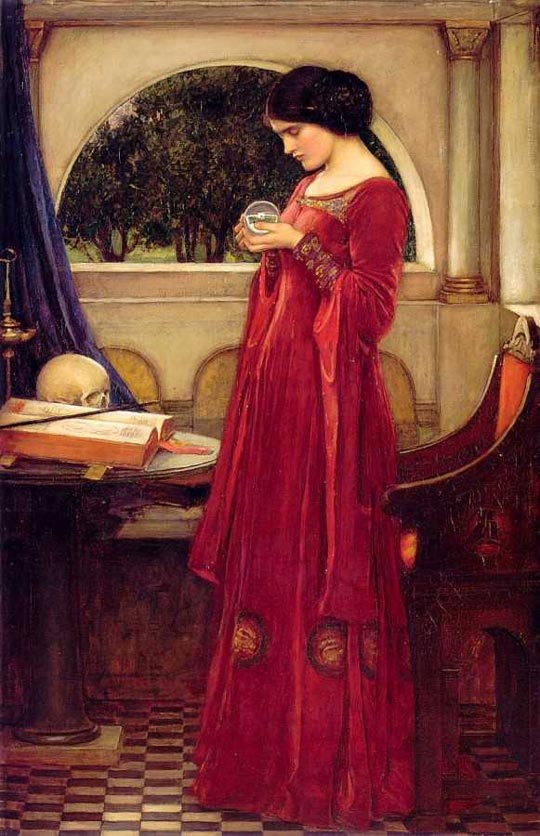
The Crystal Ball – with skull (1902)
Even with tackling just one painter for this list, it was still difficult to pick just five of Waterhouse’s paintings.  But I had to highlight The Crystal Ball but I have a print of it hanging in my dining room.  Red is my favorite colour, and it’s the accent colour in my dining room, so this print went really well on the latte coloured walls. 

The detail here again is amazing: the tiled floor, the gilding on the chair and the scrollwork on her dress ~ which again I would love to have.

Some have interpreted the figure as weaving a spell with the aid of a crystal ball, spell book and skull.  But I take away a meditation on mortality and spirituality.  Something along the lines of et in arcadia ego.


That is the beauty of art, whatever the medium: the artist paints and the viewers [or reader] takes it in, mixes it with his or her own life experiences and philosophies and sees a message written just for them.  The artist can view this personal interpretation as an annoyance: an obstacle to the message they are trying to convey.  But aren’t we also re-interpreting the subject when we paint/write/act/play?

What about you?  What do you see when you look at these paintings?  What other Waterhouse paintings inspire, excite, calm or enthrall you?

Oremus pro invicem,
~ Mikaela

Next Friday: The Top Five Paintings of Dante Gabriel Rossetti

17 June 2011

Top Five Friday: Flowering Shrubs

God made rainy days so gardeners could get housework done.
~ Author Unknown

Unless of course, the gardener is also a writer.  Rainy days are for writing and reading ~ ahem, I mean research.

Today marks the beginning of a new feature here at La Belle: Top Five Fridays.  Every Friday, I will showcase top five lists in the following arts categories: Food, Gardening, Writing, Music and the Visual Arts.

This week’s top five comes from my love of flowering shrubs.  I love these five show stoppers mostly for their vibrant colours and/or their spicy scents.  Flowering shrubs are a Godsend to the gardener: they not only provide colour, but structure as well.  And they bloom every year and need minimal care. 

All links will lead you to Nature Hills Garden Catalog.  I chose to link to them because they are an organic seed and plant catalog, but I have not actually purchased any plants from them as all the flowering shrubs I have were passed down to me.

Top Five Flowering Shrubs

Photo Credit: M. D'Eigh
Ever since I was a little girl, the lilac has been my favorite flower.  If someone brings me a bouquet of lilacs, I know they really know me!  Their very scent heralds the onset of Spring.  Best advice I’ve received about lilacs: wait until they finish blooming and then prune them.  Pruning helps them produce more blooms the following year.


Photo Credit: Adam Hickmott

These luscious, voluptuous blooms are the divas of the garden.  We currently have three mountainous shrubs on the northeast side of the house and they range from lavender to a rich violet-tinged blue.  They make a grand tabletop statement bunched in a large bowl or in a short vase.  Just make sure you get them in water pronto.  I waited too long once and only 3 of the 6 blooms perked back up when I finally placed them in water.  [Don’t ask.]

After the bold hydrangeas, I love peonies for their bright pink colour and mesmerizing scent.  Maybe mine are just quirky, but their heavy little heads are forever bowing and scrapping to some unseen garden royalty.  I come out in the morning, and there they are, dragging the ground in shame, bit of dirt between their petals.  I’ve tried peony brackets, but they simply love to bend to the ground.  If any gardeners out there have any advice, I’d be most grateful!  Bowing and scrapping notwithstanding, peonies make a wonderful addition to the garden.  And you can divide them and share with a fellow gardener.

Photo Credit: M. D'Eigh
Rhododendron
“Rhodies” are the back up singers in this band of diva-ish shrubs ~ but they give you a lot bang for you buck.  Ours live between the Hydrangeas and are also currently in the front of the house, facing southeast.  The shrubs which fast true east fare a little better than the one that faces more south.  Not sure why this is.  But we plan on re-planting them somewhere else and putting in boxwood.  As you can see from this picture, the blossoms are strong in colour, but delicate in shape.  Sadly, one big thunderstorm with heavy sheets of rain washed away all the rhodie blooms. 

Photo credit: Simon Howden
 Lavender
Silly me.  I always thought lavender was an herb, not a shrub.  But these little ladies can get pretty big!  And they bloom year after year.  Bees and butterflies love it ~ and so do I. Especially stuffed in little lacy pillows or in a container of homemade bath salts.  The lavender flower also makes a nice “bow” on a boxed gift. 

What are your top five flowering shrubs and why?

Oremus pro invicem,
~ Mikaela

14 June 2011

The Writer's Journal: Journaling to Woo the Muse

. . .the finished poem will never be as magnificent as this half-formed vision of it.
~ Linda Bierds, from The Writer’s Journal

My first journal was brass-locked and lavender with tiny blue flowers all over it ~ complete with tiny brass keys ~ that Santa brought me when I was in the fourth grade.  When I re-read my old journals, I only noticed the gaps between entries big enough for both Paul Bunyan and Babe to walk through.  Such a lack of consistency reeked of laziness and indifference. I bowed my head in shame at each missed date – oh the mortal sin of it all!

Turns out, most writers are sinners.  And in this regard at least, that’s not such a bad thing.  Your writing process should help you, inspire you, save your inky rear end when you get stuck.  If you’re chained to it, it becomes a brick wall instead of a ladder. Writing is a fluid art ~ sometimes what worked for you last year is old and tired this time around.  And journaling is just one of many ways to woo the Muse.

In “The Writer’s Journal,” Sheila Bender asked forty writers to explain how journaling affects their writing process and to share excerpts from those journals to illustrate.  The various forms of journaling that are highlighted are as diverse as the authors themselves: Janice Eidus [The Last Jewish Virgin] uses letters to “bear witness to [her] life and thoughts.” (p. 68); Ron Carlson [Betrayed by F. Scott Fitzgerald] writes bits and bobs on “envelopes, folded memos, torn slips, wedding announcements, rodeo programs and such” (p. 38) and keeps them in a shopping bag that escaped being thrown out in the garbage more than once.

A shopping bag?  And I thought my bag of various notebooks was disorganized!

To see how others writers write is at once stimulating and comforting and a fascinating read.  Now I know that when I don’t touch my journal for days, I’m in good company.  And that my system, however quirky or slightly insane it may seem to other writers, works for me.

At least for today.

Oremus pro invicem,
~ Mikaela

What works for you?  Typing in random thoughts on the computer? Writing letters to a friend?  I’d like to hear what your writing process is!

13 June 2011

Food Meme: Food from Apple to Zucchini

I was 32 when I started cooking; up until then, I just ate.
 ~ Julia Child

One of the great aspects of the 2011 Blogathon was getting to “meet” the great community of bloggers that participated.  Some had been blogging for years, other were brand-spanking new.

Bookworm has been blogging since 2009 and just recently began a series called  Civil War Sundays where they talk about different aspects of the war.  It’s fitting that they began the blog posts this year ~ the 150th anniversary of the war.

Another blog post Bookworm did recently was a Food Meme ~ one I haven’t seen before.  I love memes and haven’t participated in one in awhile.  No clue who started it, but here is my contribution:

A is for Apple: What’s your favorite variety?
Hands down: Granny Smiths.  Great in pies, cobblers and in my favorite kitchen appliance: the juicer.

B is for Bread: Regardless of nutrition, what is your favorite type?
Shameless of me, but my homemade French bread, recipe courtesy of Southern Living.

C is for Cereal: What is your favorite kind currently? (just one!)
Not a huge cereal fan, but if I had to choose, probably Cream of Wheat.  Does that count?

D is for Donuts: You might not currently eat them, but what kind do you fancy?
Before I became dairy intolerant, custard filled.  Sigh.  Now I don’t really eat them, but Paul’s Bakery in Fredericksburg has THE best doughnut holes EVER.

E is for Eggs: How would you like yours prepared?
When I could eat them? Fried.  In bacon grease.  Over easy.

F is for Fat Free: What is your favorite fat free product?
Kale?  I don’t do processed.

G is for Groceries: Where do you purchase yours?
Farmer’s Market in the summer, Whole Foods, then Trader Joe’s.

H is for Hot Beverages: What is your favorite hot drink?
Regular: chai tea.  Alcoholic: hot mead. 

I is for Ice Cream: Pick a favorite flavor and add a fun topping.
Coconut milk-based ice cream: coconut with Framboise.

J is for Jams or Jellies: Do you eat them? If so, what kind and flavor?
Pumpkin butter.  Ahhh.

K is for Kashi: Name your favorite Kashi product?
Crackers? Maybe?

L is for Lunch: What was yours today?
Ha!  Lobster roll [CT style] from The Lobster Truck with a dill pickle and an Arnold Palmer.  That and 73 degree weather and a nice breeze ~ can this day get any better?!

M is for microwave: What is your favorite microwave meal/snack?
I don’t microwave if I can help it.  Cooking with gas, baby!

N is for nutrients: Do you likes carbs, fats, or proteins best?
Proteins. Love kale, spinach and anything made of meat – in moderation of course.

O is for oil: What kind do you like to use?
Safflower for cooking.  Olive oil for everything else.

P is for protein: How do you get yours?
Chicken and greens.  Tough being a foodie who is both egg and dairy intolerant.  

Q is for Quaker: How do you like your oats?
With coconut milk, butter and brown sugar.  Or in a cookie with raisins.  Whaaaat?

R is for roasting: What is your favorite thing to roast?
Mwhahahaha.  Oh.  We’re talking about food.  Ummmm ~ red peppers?

S is for sandwich: What’s your favorite kind?
Pulled pork with homemade slaw.  The P.O.R.C. mobile has a fantastic sandwich ~ not to mention to-die-for chocolate truffles on a stick!

T is for travel: How do you handle eating while traveling?
Again, before food intolerances attacked me, I would try to find the local mom and pop places and ask for the local favorite.  Now I also look up Diners, Drive-Ins and Dives to see which places were highlighted before I travel.  I also google the nearest Whole Foods.  What can I say ~ I like my food organic!

U is for unique: What is one of your weirdest food combos?
Hmmmm.  I'll have to think about that one.  Or ask someone I've fed recently...

V is for vitamins: What kind do you take?
B Complex, Antioxidants, Flax Oil, C, E, Carotene, a dietary supplement and one other herb that’s supposed to be good for stress.

W is for wasabi: Yay or nay?
Just a pinch.

X is for XRAY: If we xrayed your belly right now, what food would we see?
Ewwwww!!  Probably lunch; possibly yesterday’s potluck dinner: fresh fruit salad [ala moi], Chinese chicken pasta salad, tomato and corn salad, sweet potato soufflé with pecans and brown sugar [Oh. My. Gosh], broiled asparagus, and green tea with raspberries.

Y is for youth: What food reminds you of your childhood?
Fried chicken [mom still makes the best], bigos [sauerkraut with kielbasa, chicken and beef], chicken and dumplings, boiled custard [there is a reason we only make it at Christmas!]

Z is for zucchini: How do you prepare it?
I don’t.  I hate it. We grew acres of it when I was a kid.  But I tolerate it in bread. ;)


What about you?

Oremus pro invicem,
~ Mikaela